
Table of Contents
ToggleHow AI is Changing the Future of Digital Marketing
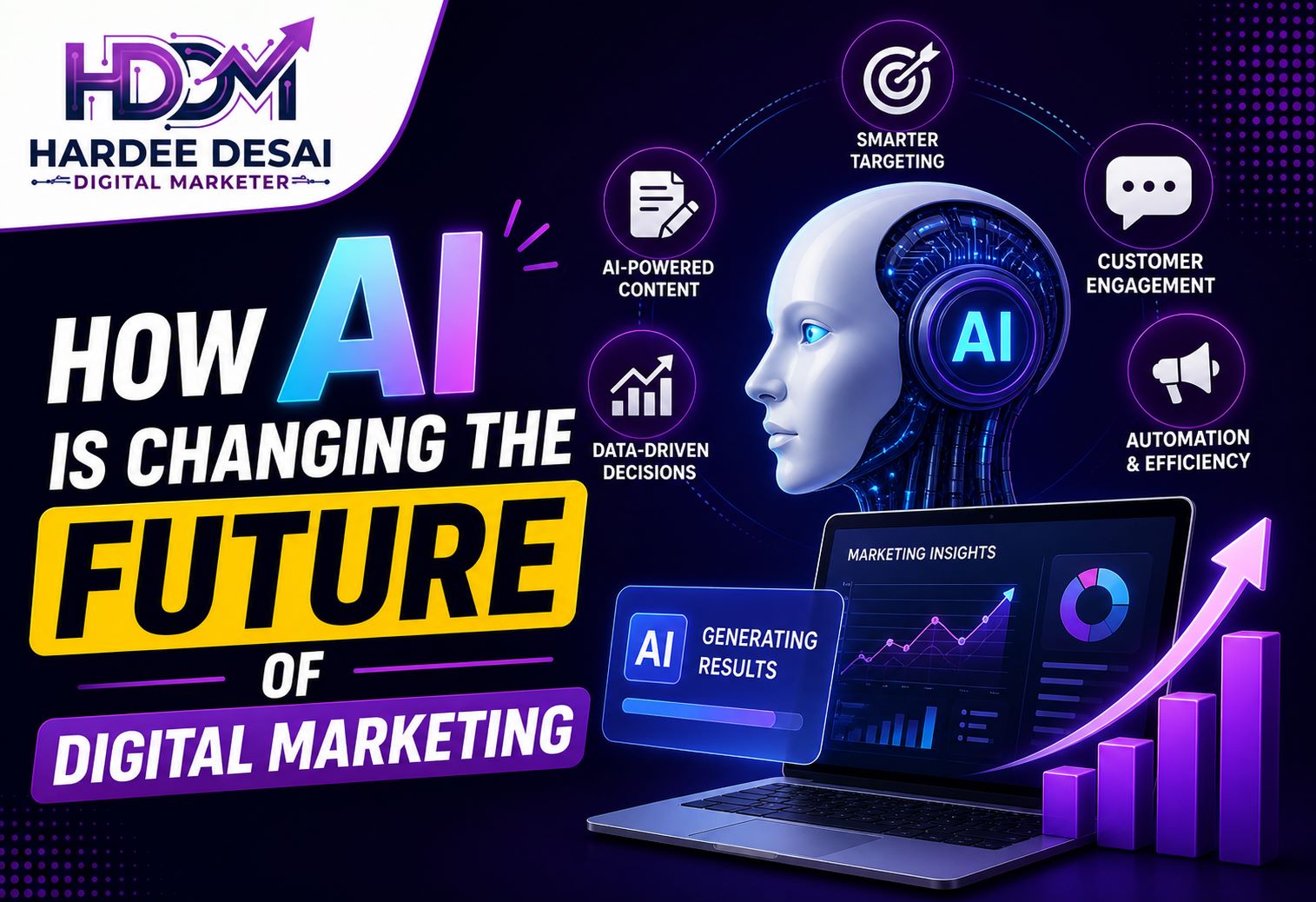
Artificial intelligence is no longer a concept reserved for tech giants and research labs. It is reshaping how brands communicate, compete, and convert customers at every level and the future of digital marketing with AI is arriving faster than most businesses realise. Understanding how AI is changing digital marketing is no longer optional for business owners, marketing professionals, or students entering the field it is essential.
From automating repetitive tasks to generating hyperpersonalised content at scale, AI is transforming every layer of the marketing stack.This comprehensive guide gives you an honest, practical picture of what AI is doing to digital marketing right now, what it means for the next five years, and exactly how to use AI tools for marketing to your advantage today.
We will explore ai marketing tools for small business that are genuinely affordable, how ai content creation for marketing is reshaping team output, and what the future of digital marketing with AI truly looks like for brands willing to act now.
How AI Is Fundamentally Changing the Way Digital Marketing Works
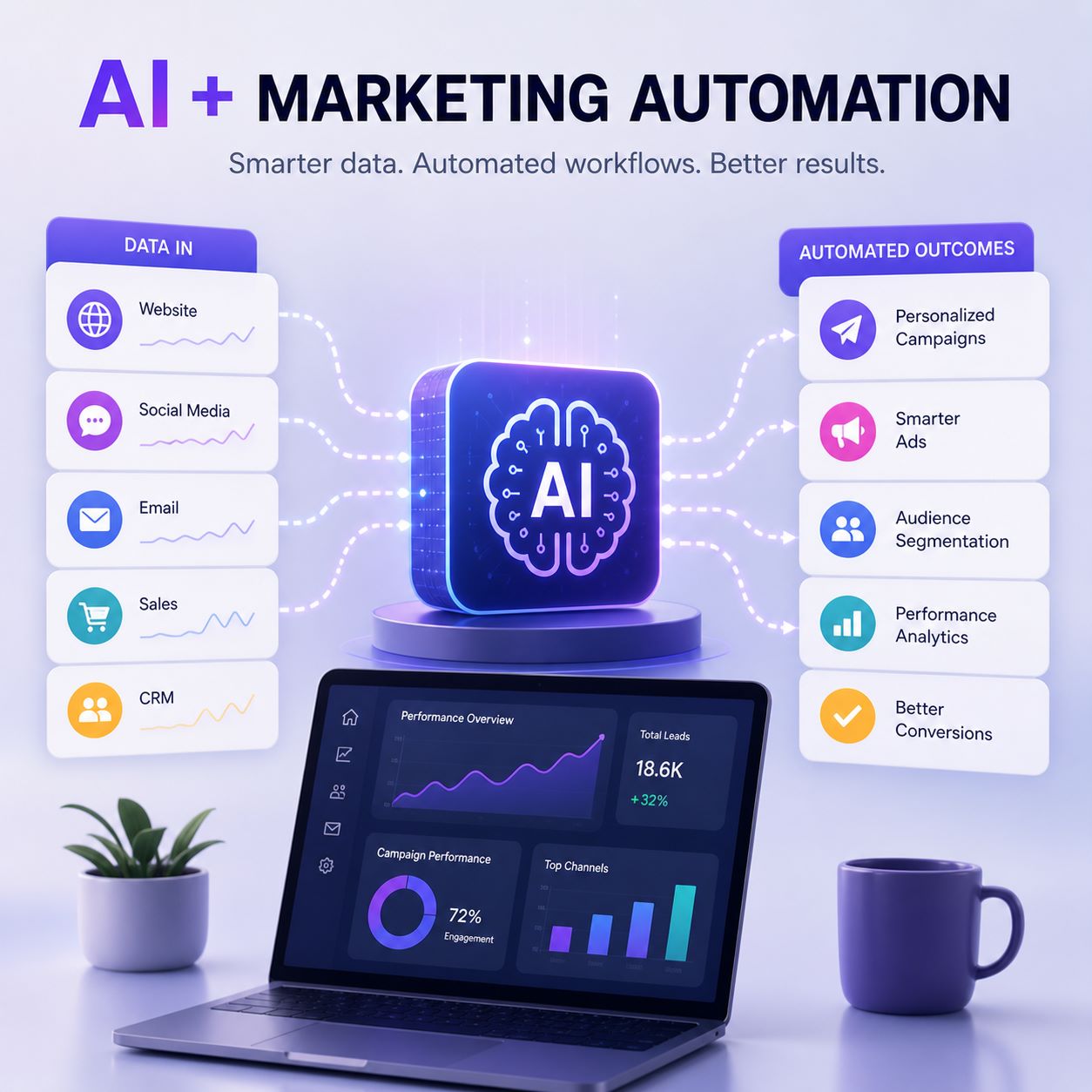
The starting point for understanding how AI is changing digital marketing is recognising a fundamental shift in how marketing decisions are made. Traditional marketing relied on human intuition, historical data, and broad audience segments.AI has changed this model entirely by enabling real-time, data driven decisions at a level of granularity that was previously impossible for any human team to achieve.
AI systems can analyse billions of data points across customer behaviour, campaign performance, and market trends simultaneously and automatically adjust strategies in real time. This means ad budgets are optimised mid campaign without manual intervention, email subject lines are personalised for individual recipients based on past behaviour, and content recommendations are dynamically tailored to each user.
The future of digital marketing with AI is one where personalisation is no longer a premium feature it is the standard expectation of every customer interaction.One of the most important aspects of how AI is changing digital marketing is the democratisation of capability.
Tasks that once required dedicated data science teams predictive modelling, audience clustering, real-time bid optimisation are now built directly into marketing platforms that any business can access. Forward thinking professionals at hardeedesai.in are already integrating these AI-powered tools to deliver more precise targeting, stronger audience insights, and significantly better ROI for clients of every size.
Real-World Examples of AI Being Used in Digital Marketing Today
To understand the future of digital marketing with AI practically, look at the platforms you already use. Google’s Performance Max campaigns use AI to automatically allocate ad spend across Search, YouTube, Display, Discover, Gmail, and Maps choosing placements and audiences most likely to convert for your specific goal.
Meta’s Advantage+ Shopping campaigns use machine learning to test thousands of ad creative variations and automatically serve the highest-performing version to the most receptive audience segments. These are direct examples of how AI is changing digital marketing at the platform level. Netflix uses AI to personalise every content recommendation for over 230 million subscribers. Spotify’s Discover Weekly playlist is built entirely by AI, analysing individual listening patterns to surface music each user is statistically likely to enjoy.
These are not experimental prototypes they are live, revenue-driving applications of AI that are generating billions in measurable business impact and defining what ai content creation for marketing and personalisation look like at scale. According to HubSpot’s 2026 State of Marketing Report, over 64% of organisations are now using AI in their marketing workflows, and 61% of marketers believe the industry is experiencing its biggest disruption in 20 years. Knowing how to use AI tools for marketing has shifted from a competitive advantage to a baseline professional expectation.
What the Future of Digital Marketing With AI Actually Looks Like
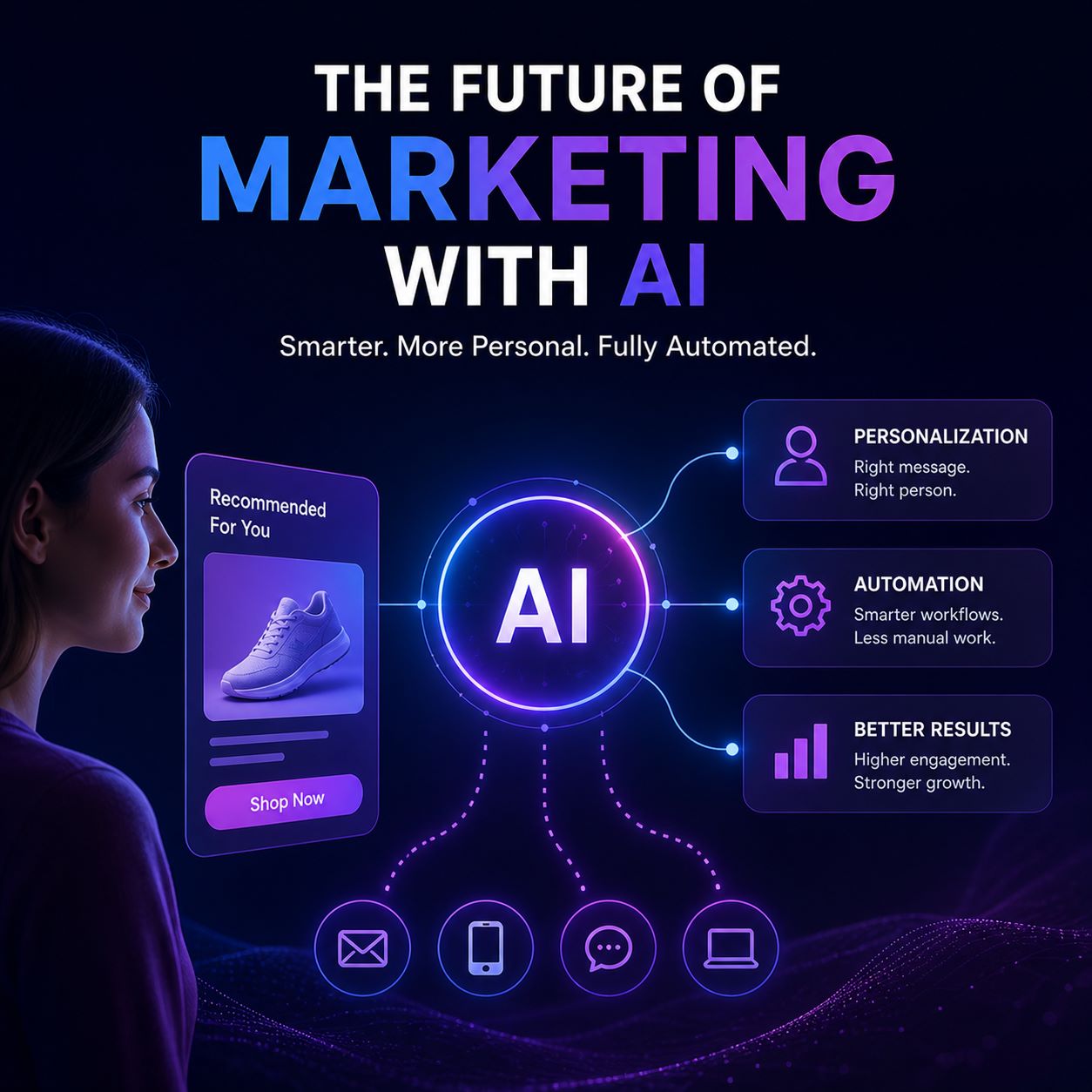
The future of digital marketing with AI points toward hyper personalisation, predictive marketing, and the automation of most manual, repetitive marketing tasks. Here is what the next three to five years will realistically look like for brands that embrace AI in their marketing strategy:
- Predictive customer journey mapping: AI will anticipate where a prospect is in their buying journey and automatically deliver the right message on the right channel at the right time without manual campaign management. This is part of how AI is changing digital marketing at the strategic level.
- AI-generated creative at scale: Brands will generate thousands of personalised ad variations, landing page headlines, and email sequences automatically tested and optimised by AI, making ai content creation for marketing a default workflow rather than an experiment.
- Voice and conversational search optimisation: As AI-powered assistants become more sophisticated, optimising for conversational queries and natural language search will become a core discipline for every brand that wants to remain visible.
- AI-driven customer service and lead qualification: Advanced AI chatbots will handle initial sales conversations, qualify leads, and provide customer support with near-human fluency freeing marketing teams to focus on strategy and creative.
- Autonomous campaign management: AI systems will plan, execute, monitor, and optimise entire marketing campaigns with minimal human input shifting the marketer’s role to strategy, creative direction, and ethical oversight.
Understanding the future of digital marketing with AI also means understanding that these capabilities are not five years away — they are already partially available in tools that every business can access today. The brands winning in 2026 are those that started implementing AI workflows in 2024 and 2025.
Artificial Intelligence in Marketing: A Beginner's Clear Overview
If you are new to this topic, here is artificial intelligence in marketing explained simply. AI in marketing refers to the use of machine learning, natural language processing, and advanced data analytics to make marketing processes smarter, faster, and more personalised than any human-only team could achieve.Machine learning allows systems to improve through experience without being explicitly reprogrammed. In marketing, this means your ad targeting becomes more accurate the more impressions and conversions it processes.
Natural language processing powers AI copywriting assistants, sentiment analysis tools, and conversational chatbots. Data analytics powered by AI can identify patterns in customer behaviour that a human analyst would take weeks to uncover and act on those insights in real time.
The critical insight for any marketer is this: you do not need to be a data scientist to use AI in your marketing strategy. Most modern marketing platforms have AI features built directly into their interfaces.The skill you need is not technical it is strategic. Understanding what AI can do, how to configure it correctly, and how to measure whether it is actually improving your results is what separates marketers who benefit from AI from those who are merely overwhelmed by it.
How to Use AI Tools for Marketing Without Getting Overwhelmed
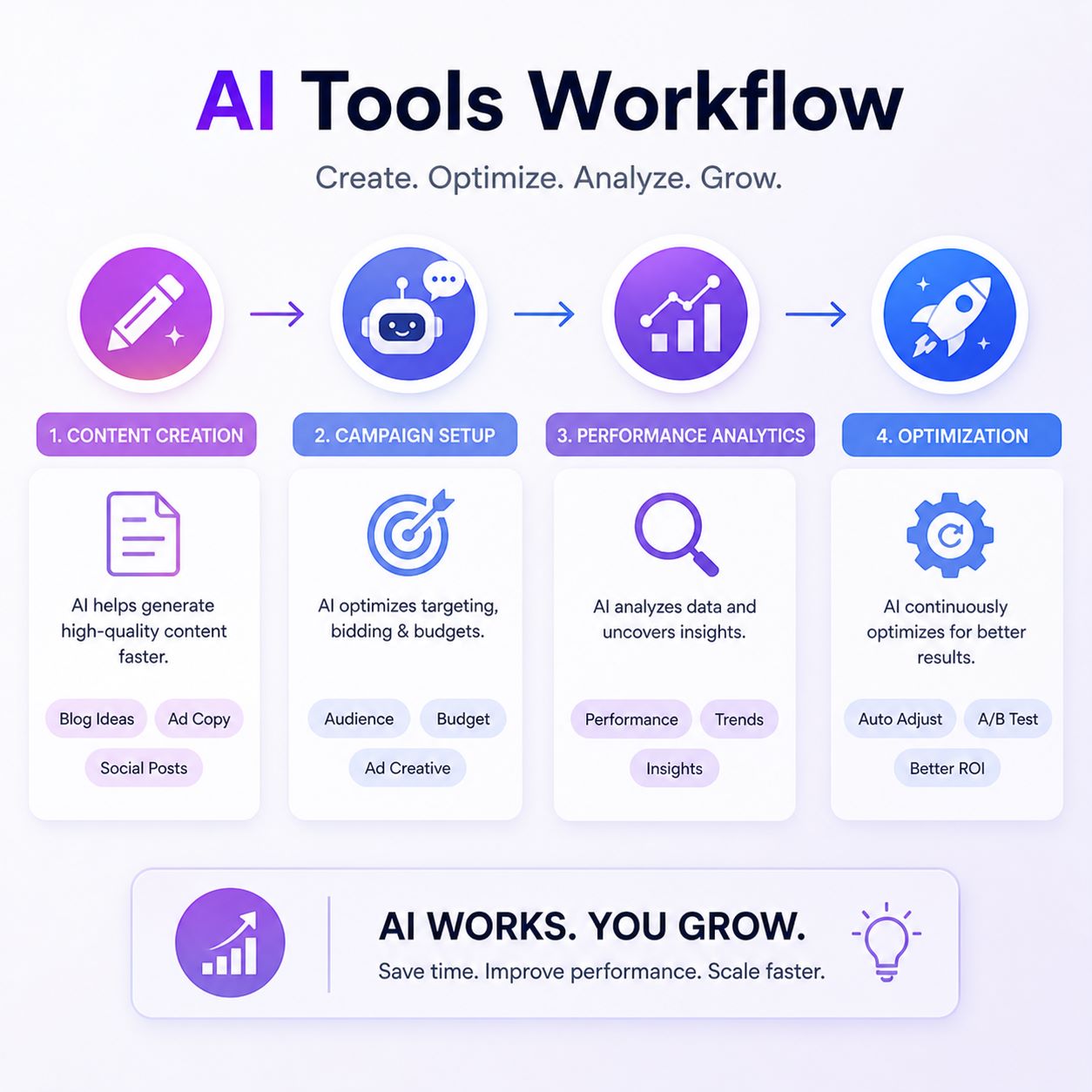
The most common mistake when beginning with AI is adopting every new tool simultaneously. A more sustainable approach to how to use AI tools for marketing is to identify one specific problem in your workflow and solve it with AI before moving on to the next application. Clarity about what you want AI to do is what separates marketers who benefit from it from those who are simply overwhelmed by it.
Start with AI for content ideation and drafting tools like Claude, ChatGPT, or Gemini can help you brainstorm blog topics, generate social media caption variations, outline email sequences, and create first drafts of marketing copy in minutes rather than hours. This is the simplest entry point into ai content creation for marketing for most teams, and it delivers immediate, measurable time savings.
After content, move to AI-assisted SEO tools like Semrush’s AI features or Surfer SEO for content optimisation and keyword research. After that, explore AI-powered scheduling, social listening, and ad management tools. The question of how to use AI tools for marketing has a different answer for every business the key is to start specific, measure results, and scale what works.
The strategic goal is to let AI handle the time consuming, repetitive parts of marketing drafting, scheduling, reporting, A/B testing so you can focus on strategy, creative direction, and relationship building. The future of digital marketing with AI is not about replacing marketers; it is about making every marketer exponentially more productive.If you are building your foundational marketing knowledge before layering in AI tools, read our guide on 10 Free Digital Marketing Tools Every Intern Should Know.
AI Marketing Tools for Small Business That Are Actually Affordable
The perception that AI is only for large enterprises with massive technology budgets is completely outdated. There are powerful ai marketing tools for small business available today at free or low cost price points that deliver genuine competitive advantages.
Knowing how to use AI tools for marketing effectively even on a limited budget is one of the most important skills a small business owner can develop right now.
- ChatGPT / Claude — for content ideation, email drafts, social media caption writing, FAQ creation, and customer communication templates. These are among the most accessible ai marketing tools for small business for anyone starting out.
- Canva AI — for generating image backgrounds, removing photo backgrounds, creating design variations, and producing brand-consistent visual content without a professional designer.
- Grammarly — AI-powered writing assistant that ensures all your marketing copy is clear, professional, and error-free before it reaches your audience.
- Google Performance Max — AI-optimised ad campaigns available to any Google Ads account regardless of budget size, that automatically allocate spend across Google’s full network.
- Mailchimp AI — for predicting the optimal time to send emails, personalising subject lines based on subscriber behaviour, and segmenting audiences automatically. A genuinely useful ai marketing tool for small business teams focused on email.
- Tidio or ManyChat — AI-powered chatbots for website and Instagram DM automation that can qualify leads and answer common customer questions 24/7.
- Semrush free tier — for AI-assisted keyword research, competitive analysis, and content gap identification that inform your content and SEO strategy.
Small businesses that integrate even two or three of these ai marketing tools for small business immediately gain a measurable efficiency advantage over competitors who are doing everything manually. Learning how to use AI tools for marketing in your specific business context starting with one tool, measuring the impact, then expanding is the practical path to results without overwhelm.
Will AI Replace Digital Marketers? An Honest Answer
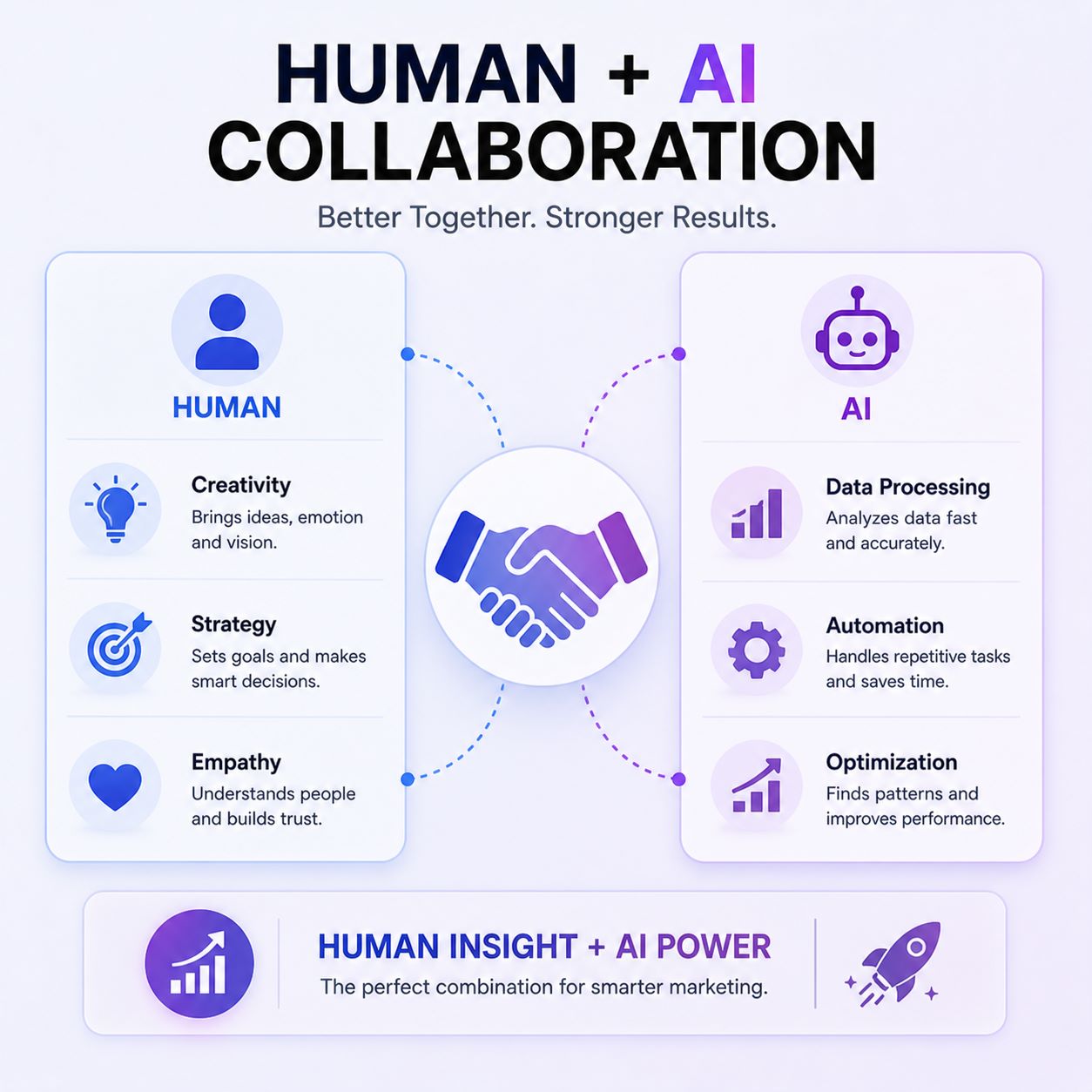
This question comes up constantly, and the answer requires nuance. AI will replace specific marketing tasks particularly the repetitive, data processing, and templated content creation tasks that occupy a significant portion of many marketers’ daily work.But understanding how AI is changing digital marketing roles reveals a more important truth: AI will not replace marketing professionals who think strategically, build genuine human connections, understand cultural nuance, exercise ethical judgment, and apply creative vision to complex brand challenges.
The marketers most at risk are those who resist learning AI tools and continue working exactly as they did five years ago. The marketers who will thrive in the future of digital marketing with AI are those who learn to use it as a force multiplier letting AI handle volume and analysis work while focusing their own effort on the thinking and relationship-building that genuinely requires human intelligence.
The best analogy is the calculator in mathematics. Calculators did not eliminate mathematicians; they freed mathematicians from arithmetic so they could solve more complex problems. AI is doing the same for marketers especially those who have invested time in mastering how to use AI tools for marketing strategically. The most effective marketers in 2026 are not those who avoid AI they are those who have made it a core part of how they work.
AI Content Creation for Marketing: How It Is Reshaping Teams and Output
AI content creation for marketing is one of the fastest growing applications of artificial intelligence in the industry, and its impact on marketing team productivity is genuinely transformative. AI writing tools can generate first drafts of blog posts, social media captions, email sequences, product descriptions, and ad copy in seconds dramatically compressing the time between idea and published content. Understanding how AI is changing digital marketing team workflows through content automation is essential for any business planning its 2026 strategy.
This does not mean marketing teams are shrinking. It means they are producing significantly more content than before, with AI handling the heavy lifting of initial drafting while human marketers focus on editing, strategic alignment, and ensuring brand voice consistency.
Teams that previously published two blog posts per month can now publish eight to ten with the same headcount, simply by using ai content creation for marketing as part of their workflow. The critical skill emerging from this shift is prompt engineering the ability to give AI tools precise, context-rich instructions that result in high-quality, brand aligned outputs.
The better your prompts, the better your AI-generated content will be. Marketers who master how to use AI tools for marketing through well crafted prompts will consistently outperform those who rely on vague, one-line requests. This is rapidly becoming one of the most valuable competencies in modern marketing.
For ai content creation for marketing to deliver genuinely strong SEO results, AI-generated content must also meet on-page optimisation standards. Read our complete guide on the On-Page SEO Checklist Every Blogger Should Follow ensuring every AI-generated piece meets every SEO requirement before you publish.
AI vs Traditional Marketing: Which Approach Should You Actually Be Using?
The debate of AI versus traditional marketing misses the point entirely. The most effective modern marketing strategies combine both. Traditional marketing principles understanding your audience deeply, crafting a compelling and emotionally resonant message, building long-term brand trust are as relevant and important as they have ever been. AI provides the tools to apply those timeless principles at greater scale, speed, and precision than any purely human team could achieve.
AI-powered digital marketing excels at personalisation at scale, real-time optimisation, predictive analytics, automated A/B testing, and processing large datasets to identify patterns that humans cannot see. Traditional marketing principles excel at brand strategy, creative vision, emotional storytelling, cultural relevance, and the long-term relationship building that creates genuine customer loyalty.
The winning approach is to treat AI as a powerful and evolving tool within your marketing toolkit, not as a replacement for the strategic thinking and human creativity that make marketing genuinely effective. The future of digital marketing with AI belongs to brands and marketers who understand how to combine both.
The Real Benefits of AI in Digital Marketing — Beyond the Hype
The genuine, measurable benefits of AI in digital marketing come down to four core improvements that any business can realistically achieve and that represent exactly how AI is changing digital marketing operations for brands of every size:
- Speed: Tasks that previously took hours now take minutes content drafts, audience segmentation, campaign setup, data analysis, and performance reporting all accelerate dramatically with AI assistance and effective ai content creation for marketing
- Personalisation: AI enables genuinely individualised customer experiences at a scale no human team could match from personalised email subject lines to dynamic website content that adapts to each visitor’s behaviour and preferences.
- Accuracy: AI reduces human error in data analysis and campaign management, making optimisation decisions based on patterns across thousands of data points rather than gut feeling or limited manual review.
- Cost efficiency: By automating repetitive tasks, ai marketing tools for small business allow smaller teams to produce results that previously required significantly larger headcounts and larger budgets.
These are not theoretical benefits. Brands that have integrated AI into their marketing workflows consistently report higher campaign ROI, lower customer acquisition costs, and faster content production cycles. The future of digital marketing with AI is not a future scenario it is measurably the present reality for brands moving fast enough to adopt it.
F.A.Q
Is AI in marketing only useful for large companies?
Absolutely not. The most effective ai marketing tools for small business — including Canva AI, ChatGPT, Google Performance Max, and Mailchimp AI — are available at free or low-cost tiers and used daily by solo entrepreneurs and small teams. In fact, small businesses that adopt AI tools early gain a disproportionate competitive advantage because they can produce the same quality and volume of marketing output as larger competitors with a fraction of the headcount and budget. The future of digital marketing with AI democratises capability size is no longer a barrier to sophisticated, personalised marketing.
How does AI improve Google Ads campaign performance?
This is one of the most direct examples of how AI is changing digital marketing in paid advertising. AI in Google Ads manifests through Smart Bidding, which uses machine learning to adjust bids in real time based on dozens of signals device, location, time of day, and audience behaviour to maximise conversions within your budget. Performance Max campaigns use AI to automatically allocate spend across all Google channels and test creative variations automatically. Responsive Search Ads test up to 15 headline and 4 description combinations, then serve the highest-converting version for each individual query. These AI features collectively improve conversion rates while reducing manual management time significantly.
Can AI write good marketing content, or does it need human editing?
AI content creation for marketing can produce very solid first drafts of blog posts, email sequences, social captions, and product descriptions — but almost always benefits from human editing before publication. Current AI writing tools sometimes produce generic phrasing, miss brand-specific nuance, or include factual inaccuracies that require verification. The ideal workflow combines AI for drafting speed with human editing for quality, brand voice, accuracy, and strategic alignment. Think of ai content creation for marketing as a fast research and drafting assistant — your expertise turns the output into something genuinely effective and on-brand.
What is prompt engineering and why does every marketer need to learn it?
Prompt engineering is the core skill behind knowing how to use AI tools for marketing effectively. It refers to the ability to write instructions for AI tools that consistently produce high-quality, accurate, and useful outputs. The quality of what any AI tool generates is directly proportional to the clarity and specificity of the instruction it receives. A marketer who knows how to use AI tools for marketing through well-crafted, context-rich prompts — specifying audience, tone, format, length, goal, and constraints — will consistently outperform someone sending vague one-line requests. Prompt engineering is becoming as fundamental as knowing how to write a good creative brief.
How is AI changing SEO and content marketing?
Part of how AI is changing digital marketing is the transformation of SEO workflows. AI-powered tools like Surfer SEO, Semrush, and Clearscope analyse top-ranking content and provide specific, data-driven recommendations for keyword inclusion, content structure, word count, and topical depth. Second, Google’s own AI systems — Gemini, RankBrain, and BERT — are becoming more sophisticated at understanding search intent, increasingly rewarding content that genuinely and comprehensively answers user questions. Brands using ai content creation for marketing alongside smart SEO tools are producing content that ranks faster and ranks more consistently than those producing content manually.
What are the ethical concerns around AI in marketing?
The main ethical concerns around AI in digital marketing include data privacy, where AI systems require vast amounts of consumer data raising important questions about consent and appropriate usage; manipulation, where highly personalised targeting can exploit psychological vulnerabilities if used irresponsibly; and transparency, as consumers often do not know when they are being targeted by AI-driven personalisation systems. Responsible use of ai marketing tools for small business and enterprise-level platforms alike requires clear data privacy policies, transparent communication, and consistent human oversight of all AI-driven campaigns to ensure they meet both legal requirements and ethical standards.
How do I measure whether AI tools are actually improving my marketing results?
Establish clear baseline metrics before introducing any AI tool, then measure consistently after 30, 60, and 90 days. Key metrics include content production volume and time per piece (is ai content creation for marketing making you more efficient?), campaign conversion rates (are ai marketing tools for small business outperforming manual campaigns?), email open and click-through rates (is AI personalisation increasing engagement?), and overall marketing cost per customer acquisition. Data-driven measurement is the only reliable way to evaluate whether AI is genuinely improving your results and delivering on the promise of the future of digital marketing with AI.
What is the difference between AI and automation in marketing?
Automation in marketing refers to pre-programmed workflows that execute without manual intervention — sending a welcome email when someone subscribes, or publishing scheduled social media content at a set time. Automation follows fixed rules set by a human. AI, by contrast, learns from data and adapts its behaviour over time. This distinction is central to understanding how AI is changing digital marketing beyond basic automation. An AI-powered email system identifies which subject lines perform best for different audience segments and automatically adjusts future campaigns without being reprogrammed. AI adds intelligence, adaptability, and continuous improvement to automation — making systems progressively smarter the more data they process.
Should I disclose when I use AI to create marketing content?
This is an evolving ethical and legal question without a definitive universal answer. Currently, disclosure is not legally mandated in most markets for AI-assisted content creation. However, from a brand trust and authenticity perspective, transparency about your use of ai content creation for marketing — especially if your brand is built on personal expertise or human craftsmanship — is generally advisable and increasingly expected by savvy consumers. Brands that are honest about how they work tend to build stronger, more durable trust than those that project an illusion of entirely human-created content.
How should a small business owner start with AI marketing in 2026?
The most practical starting point for any small business owner exploring ai marketing tools for small business is to identify your biggest marketing time drain and solve it first. If writing content is your bottleneck, start with ChatGPT or Claude — these are the most accessible entry points into ai content creation for marketing. If social media consistency is the challenge, start with Canva AI and a free scheduling tool like Buffer. If you are running Google Ads manually, activate Smart Bidding and explore Performance Max. Learning how to use AI tools for marketing one step at a time — picking one problem, solving it, measuring the improvement, then expanding — builds real confidence and measurable results rather than overwhelming you with too many tools simultaneously.