
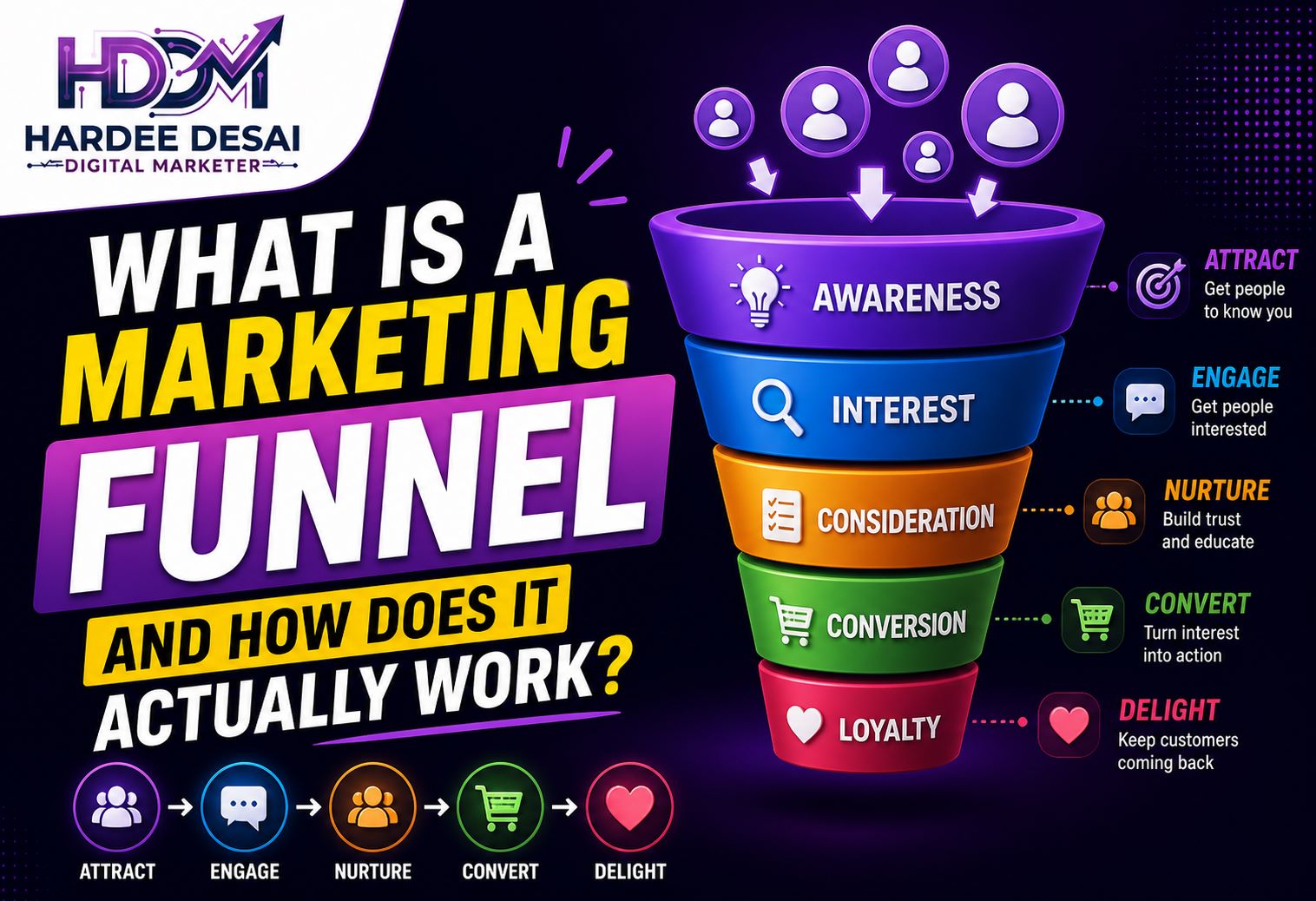
Every time a potential customer searches for a solution online, clicks on your content, considers your offer, and eventually decides to buy they are moving through what marketers call a marketing funnel. Understanding what is a marketing funnel is not a concept reserved for large corporations or experienced marketing professionals. It is one of the most practical, results driven frameworks that any business owner, freelancer, content creator, or student can understand and apply immediately. A well structured marketing funnel transforms the guesswork of business growth into a predictable, measurable system one that consistently converts strangers into leads and leads into paying clients.
This comprehensive beginner’s guide explains what is a marketing funnel with crystal-clear examples, breaks down every stage in plain English, walks you through building one from scratch, and shows you how a marketing funnel for small business can be just as powerful as those used by industry giants without a massive budget or a large team.
What Is a Marketing Funnel? A Plain-English Explanation
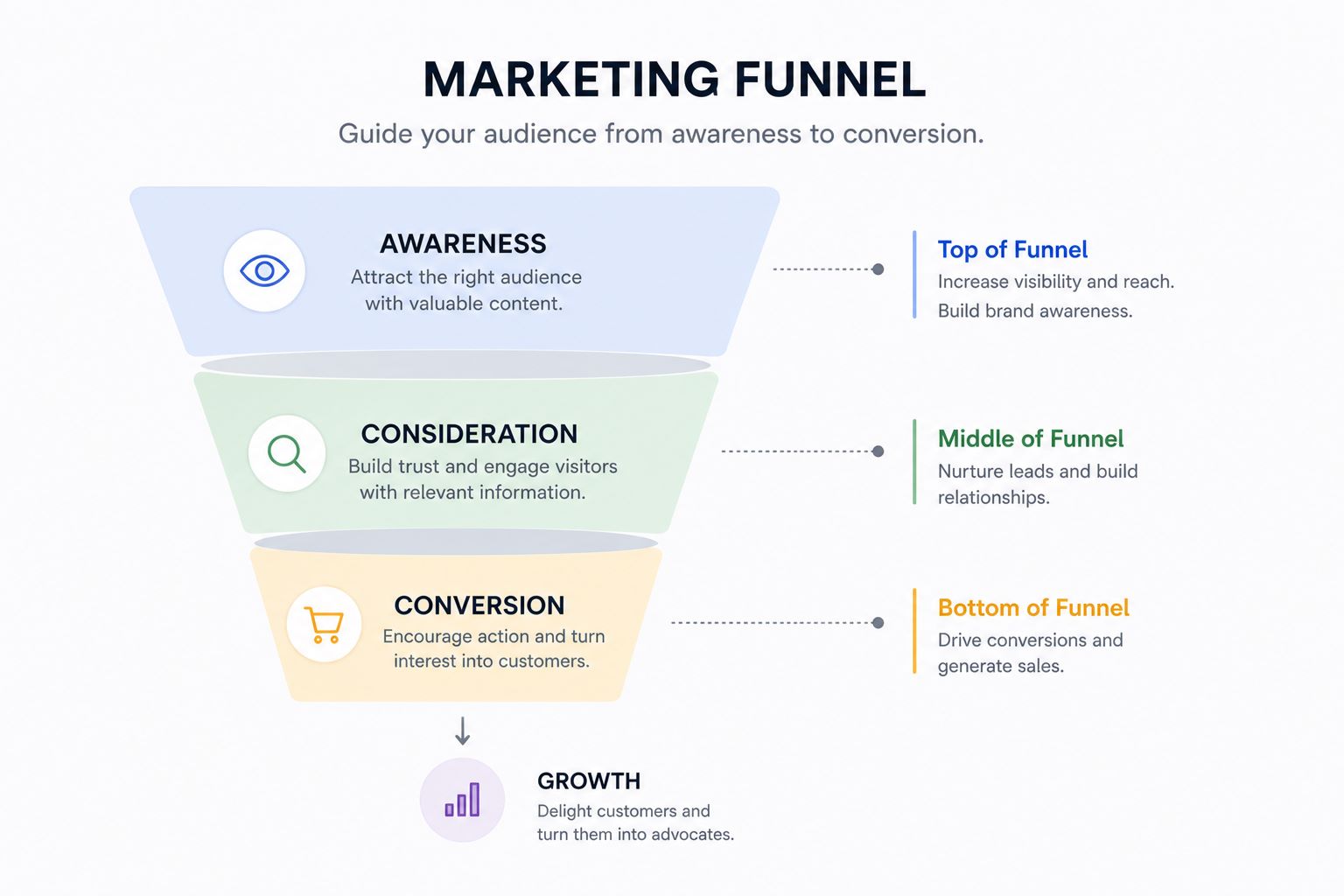
What is a marketing funnel? A marketing funnel is a strategic model that describes the complete journey a prospect takes from the very first moment they discover your brand to making a purchase and, ideally, becoming a loyal repeat customer. It is called a marketing funnel because, visually, it resembles a funnel: a large number of potential customers enter at the wide top during the awareness phase, and a smaller, more qualified group progresses through to the narrow bottom where conversion happens.
When people ask what is a marketing funnel, the most direct answer is this: it is a structured map of your customer’s decision-making process, and your job as a marketer or as a business owner is to guide prospects through each stage as effectively as possible. At each stage of the marketing funnel, the mindset of your prospect is different, which means the messages, content types, and tactics you use must also be different. Understanding this is the foundation of effective digital marketing.
Hardee Desai’s digital marketing services are built entirely around this marketing funnel philosophy mapping the customer journey first, then building targeted strategies for every stage.
The Marketing Funnel Explained So Simply Anyone Can Understand It
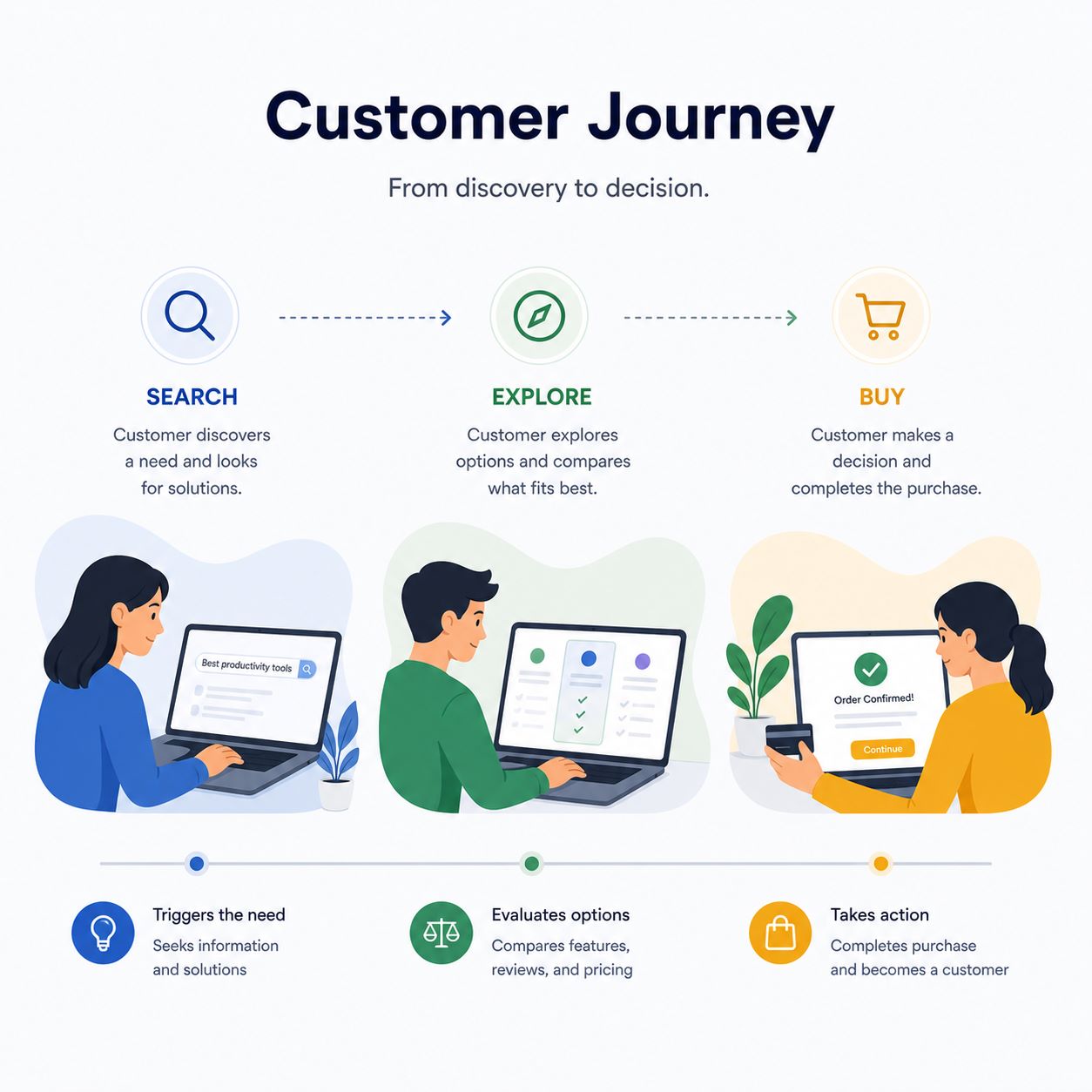
Here is the marketing funnel explained simply through an everyday scenario that removes all jargon. Imagine someone types “how to get more clients for my business” into Google. They land on a blog post — this is the awareness stage of the marketing funnel. They read it, find it genuinely useful, and click through to explore the agency’s services — this is the interest stage. They compare the agency with two competitors and check client reviews this is the consideration stage. They request a free consultation this is the intent stage. They sign up for a service package — this is the conversion stage. They refer a colleague three months later this is the advocacy stage.
This is exactly the marketing funnel explained simply in a real digital marketing context. Notice that each stage required something different informational content, trust signals, social proof, a clear offer, and a post-purchase follow-up system. The marketing funnel gives you a framework to build each of these pieces intentionally, so you are never leaving business to chance.
The real power of understanding what is a marketing funnel is that it reveals exactly where your business is losing potential customers. Once you can see the stages clearly, you can identify which part of your funnel is leaking whether it is awareness, consideration, or conversion and fix the right problem instead of wasting budget on the wrong one.
Sales Funnel vs Marketing Funnel: What's the Real Difference?
The sales funnel vs marketing funnel question is one of the most common points of confusion among business owners and new marketers. People often use the two terms interchangeably, but there is an important and highly practical distinction.
A marketing funnel covers the entire customer journey from the very first moment a prospect discovers your brand through to long-term retention, repeat purchase, and referral. It encompasses brand discovery through SEO and social media, content engagement, email lead nurturing, purchase conversion, and the post purchase experience. The marketing funnel is a broad, multi-channel strategy that touches content creation, paid advertising, email marketing, and customer experience.
A sales funnel, by contrast, refers specifically to the narrower process that begins once a prospect has already expressed clear interest. The sales funnel is focused on lead qualification, needs assessment, proposal, negotiation, and closing the deal it operates primarily within a sales team’s workflow rather than a content or digital marketing team.
For business owners and freelancers, the sales funnel vs marketing funnel distinction is practically important: if you are struggling to generate awareness and qualified leads, your marketing funnel needs attention. If you have plenty of enquiries but a low closing rate, your sales process is the bottleneck. Knowing what is a marketing funnel versus a sales funnel helps you diagnose the right problem and implement the right solution saving significant time and money.
Breaking Down the Stages of a Marketing Funnel
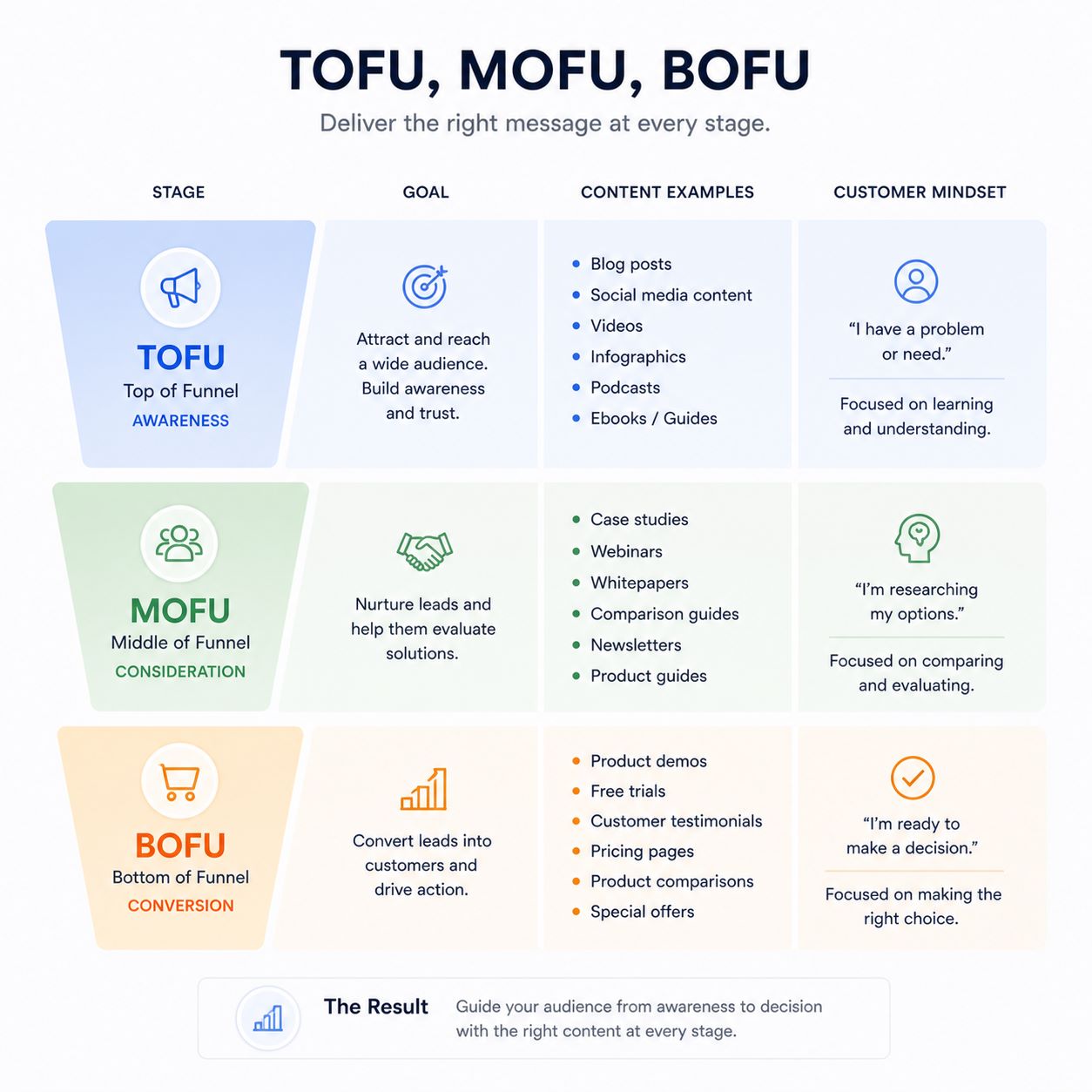
The stages of a marketing funnel are typically understood through three structural levels: top of funnel (TOFU), middle of funnel (MOFU), and bottom of funnel (BOFU) — plus a post-purchase stage that most businesses overlook. Understanding the stages of a marketing funnel tells you exactly what content to create and what strategy to use at each point in your customer’s journey
Top of Funnel (TOFU) — Awareness Stage:
At the top of the stages of a marketing funnel, your prospect encounters your brand for the very first time. They are not in buying mode they are looking for information, solutions to a problem they have just identified, or answers to questions they are searching for. Your goal at this stage is to educate, entertain, or inspire while creating a strong, memorable first impression.
Effective top of funnel content includes SEO optimised blog posts that answer the exact questions your audience types into Google, short form Reels or YouTube videos that quickly solve a specific pain point, podcast appearances, guest articles on industry publications, and organic social media content that positions your brand as a genuinely helpful authority. Neil Patel’s in-depth marketing funnel guide highlights a critical insight that resonates with every experienced marketer: the awareness stage is where most businesses dramatically underinvest their time and budget yet it is the single stage that determines how many qualified prospects ever reach the conversion stage of the stages of a marketing funnel.
Middle of Funnel (MOFU) — Consideration and Interest Stage
The middle of the stages of a marketing funnel is where genuine relationship-building happens. At this stage, your prospect is actively researching solutions, comparing you to competitors, and deciding whether to trust you enough to take the next step. Your goal is to demonstrate deep expertise, provide compelling social proof, and address the specific objections that stand between consideration and commitment.
Effective middle-of-funnel content includes detailed case studies and client results, email nurturing sequences that deliver consistent value, free consultation offers or strategy sessions, webinars or live Q&A sessions that showcase your knowledge, and comparison guides that address the sales funnel vs marketing funnel questions your audience is asking. The middle of the stages of a marketing funnel is where most businesses lose prospects simply because they fail to follow up consistently or provide enough trust signals to move things forward.
Bottom of Funnel (BOFU) — Conversion Stage
The bottom of the stages of a marketing funnel is where buying decisions are made. Your prospect at this stage understands their problem, has evaluated their options, and is ready to commit — but they need friction removed. A confusing checkout process, an unclear offer, a slow response to an enquiry, or a vague call to action can cause even highly interested prospects to abandon the funnel at the last moment.
Effective bottom-of-funnel tactics include clear and specific calls to action on every conversion page, simple mobile-optimised enquiry or purchase flows, live chat for immediate last-minute questions, strong money-back guarantees or risk reversals that reduce perceived risk, and retargeting ads that re-engage prospects who visited but did not convert. The key principle at the bottom of the stages of a marketing funnel is this: do not sell harder — make it easier to say yes.
Post-Purchase Stage — Retention and Advocacy
The most overlooked of all the stages of a marketing funnel is what happens after the sale. A customer who had an outstanding post-purchase experience becomes a loyal repeat buyer and an enthusiastic referral source — effectively feeding new qualified prospects back into the top of your marketing funnel at no additional cost. Post-purchase strategies include personalised onboarding email sequences, proactive client check-in calls at 30, 60, and 90 days, loyalty incentives, referral reward programmes, and a systematic process for gathering testimonials and detailed case studies. Every business that invests in the post-purchase stage of the stages of a marketing funnel significantly reduces its customer acquisition cost over time — a particularly critical advantage for a marketing funnel for small business.
The Digital Marketing Funnel Steps You Need to Know
The digital marketing funnel steps adapt the traditional marketing funnel framework for online channels and digital customer behaviour. Understanding the digital marketing funnel steps is essential for any business trying to grow its online presence, because digital channels offer a level of precise measurement and audience targeting at every stage that traditional media simply cannot match.
Here are the core digital marketing funnel steps in sequence:
- Attract (Awareness): Use SEO content, social media posts, YouTube videos, Google Search Ads, and Meta Ads to reach people actively searching for solutions you provide. The goal at this digital marketing funnel step is maximum qualified reach — bringing the right audience into the top of your funnel.
- Capture (Interest): Convert website visitors into known contacts through lead magnets, opt-in forms, and free resource downloads. This transition from anonymous visitor to identified lead is one of the most critical digital marketing funnel steps.
- Nurture (Consideration): Deliver consistent value through automated email sequences, retargeting ads, and remarketing content that keeps your brand visible and builds trust with leads who are not yet ready to buy.
- Convert (Conversion): Use clear landing pages, strong calls to action, simple booking or purchase flows, and fast follow-up to turn engaged leads into paying clients. This digital marketing funnel step is where your revenue is generated.
- Retain (Post-Purchase): Deliver exceptional results, send proactive check-in communications, request referrals, and build loyalty systems that keep clients returning and recommending.
How to Use a Marketing Funnel Even as a Small Business
One of the most common misconceptions about what is a marketing funnel is that it requires large budgets, big teams, or enterprise-level technology. The truth is that a well-designed marketing funnel for small business is not only achievable — it is one of the most powerful competitive advantages a small business can build. A smart marketing funnel for small business actually levels the playing field, allowing you to compete with larger competitors by being more targeted, more responsive, and more relationship-driven in your approach.
The key to building an effective marketing funnel for small business is to focus on one stage at a time rather than trying to build everything simultaneously. Start by creating 3 to 5 high-quality SEO blog posts that answer the questions your ideal customers are searching for — this is your top-of-funnel awareness engine. Add one compelling lead magnet (a free checklist, template, or guide) and a simple email opt-in form — this transitions visitors into your middle-of-funnel nurturing sequence.
For the conversion stage of your marketing funnel for small business, you do not need a complex automated system. A clear service page, a simple booking form, and a responsive follow-up process are enough to start converting leads into clients. As you grow, you can add automation, retargeting, and more sophisticated nurturing sequences. The most important thing is to start with a functional marketing funnel for small business and improve it based on real data rather than waiting until everything is perfect before launching.
Brands that combine a well-structured marketing funnel for small business with consistent content creation and a strategic approach to social media consistently outperform competitors who post reactively without a system. Explore Hardee Desai’s SEO and Content Services for expert support in building and optimising your complete marketing funnel for small business.
Awareness, Consideration, Conversion: Understanding Your Funnel Stages
If you want to remember the stages of a marketing funnel in the simplest possible way, the framework of awareness, consideration, conversion gives you a clean, actionable model. Each word represents a distinct phase of your customer’s thinking and a distinct phase of your marketing strategy.
Awareness is the stage where you answer: how does someone who has never heard of your brand discover you? This is where SEO content, social media posts, paid ads, and PR work to make your brand visible to people searching for solutions you provide.
Consideration is the stage where you answer: why should someone trust you over everyone else they are evaluating? This is where case studies, testimonials, free consultations, and detailed nurturing sequences do the heavy lifting. The prospect knows you exist — now they are deciding if you are the right choice.
Conversion is the stage where you answer: what makes it easy and compelling for the prospect to take action right now? This is where your offer clarity, your call to action, your pricing structure, and your risk reversal come together. When the awareness, consideration, conversion stages are designed with intentionality and alignment, the marketing funnel becomes a reliable, repeatable business growth system rather than a vague marketing concept.
How to Build a Marketing Funnel Step by Step from Scratch
Understanding what is a marketing funnel is valuable — but knowing how to build a marketing funnel step by step is what actually drives business results. Here is a practical, proven process for building a marketing funnel from scratch that works for service businesses, freelancers, e-commerce stores, and consultants alike.
- Step 1 — Define your ideal customer precisely: Before you build anything, get absolute clarity on who your marketing funnel is designed to serve. What specific problem do they face? What language do they use to describe it? Where do they spend time online? What would make them trust you? Every element of your marketing funnel should be designed around the answers to these questions.
- Step 2 — Map the funnel stages to your customer’s real journey: Identify what your ideal customer needs to know, feel, and trust at each of the stages of a marketing funnel. What questions do they have at the awareness stage? What objections do they hold at the consideration stage? What would make them feel confident enough to commit at the conversion stage?
- Step 3 — Create awareness content: Write 3 to 5 SEO blog posts targeting the specific questions your ideal customer searches for before they know they need your service. Pair this with consistent social media content — short-form Reels, educational carousels, and engagement-focused posts. This is your top-of-funnel traffic engine for the marketing funnel.
- Step 4 — Build a high-value lead magnet: Create a free, immediately useful resource that solves a specific problem your target audience faces today — a checklist, a template, a mini-guide, or a free audit. This is the mechanism that transitions awareness visitors into middle-of-funnel leads in your marketing funnel.
- Step 5 — Set up an email nurturing sequence: Write a 5 to 7 email sequence that delivers genuine value over 10 to 14 days after someone downloads your lead magnet. Each email should educate, build credibility, address a common objection, and naturally lead toward your main service offer. Email remains the highest-converting channel in any marketing funnel when executed with authentic intent.
- Step 6 — Optimise your conversion point: Create a clear, frictionless offer page with a single, unmistakable call to action. Remove every element that might distract from the desired action. Ensure your offer is specific, your value is clear, and saying yes is as simple as possible. This is where your marketing funnel converts interest into revenue.
- Step 7 — Build your post-purchase retention system: Design a post-purchase experience that exceeds expectations. A personalised onboarding sequence, proactive check-in communications, and a simple referral programme turn your marketing funnel from a one-time acquisition system into a compounding growth engine. This is especially powerful for a marketing funnel for small business where every retained client and every referral has significant impact.
A Content Marketing Funnel Strategy That Guides Buyers to a Decision
A content marketing funnel strategy uses specific types of content at each stage of the marketing funnel to move prospects forward naturally — without pressure tactics or aggressive selling. When your content is aligned to your stages of a marketing funnel, every blog post, video, email, and social media post has a clear strategic purpose.
At the top of the content marketing funnel strategy, create content that answers the questions your audience searches for before they know they need your specific service. This is educational and empowering content — SEO blog posts like this one on what is a marketing funnel, how-to videos, and informative social media posts that position your brand as a trusted, expert resource.
At the middle of the content marketing funnel strategy, create content that builds deep trust and addresses real objections. Detailed case studies showing measurable results, comparison content (like sales funnel vs marketing funnel breakdowns), FAQ posts addressing common hesitations, and email sequences that deliver weekly value all serve this purpose.
At the bottom of the content marketing funnel strategy, create conversion-focused content — clear service pages with specific, outcomes-focused language, client testimonials, and strong calls to action. For a practical framework to plan your content marketing funnel content calendar, explore our blog on How to Create a Social Media Content Calendar from Scratch — the same planning principles apply directly to marketing funnel content strategy.
Lead Generation Funnel Explained: How to Turn Strangers into Leads
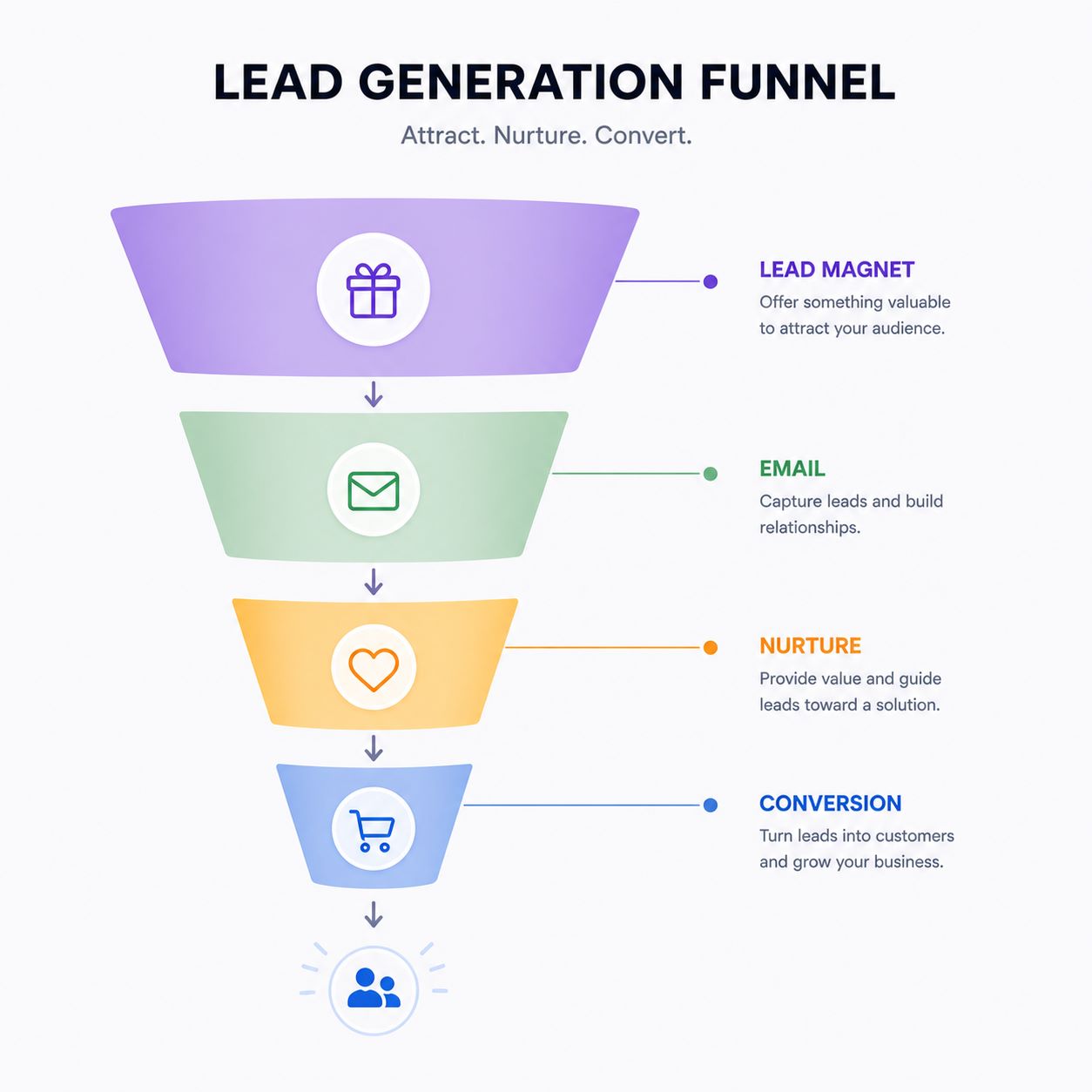
With the lead generation funnel explained, you will understand the most critical sub-system of any complete marketing funnel. A lead generation funnel is the mechanism that attracts people who have never heard of your brand, offers them something genuinely valuable in exchange for their contact information, and begins the nurturing process that ultimately leads to a sale. Without a functioning lead generation funnel, even the best product or service will struggle to reach a consistent flow of qualified prospects.
The most effective lead generation funnel combines three essential components: a high-traffic awareness asset (an SEO blog post, a viral social media Reel, or a targeted paid ad that reaches your ideal customer), a compelling and highly specific lead magnet that delivers immediate, practical value (not a vague, generic eBook), and a simple opt-in page that captures name and email with minimal friction.
The quality of your lead magnet is the single biggest variable determining the success of your lead generation funnel. A lead magnet that is specific, immediately actionable, and solves a real, current problem consistently outperforms generic resources. For example, ‘The 7-Point Instagram Profile Audit Checklist for Service Businesses’ will generate far more downloads — and far more qualified leads into your marketing funnel — than a generic ‘Ultimate Instagram Guide.’
Once leads enter your lead generation funnel, the quality of your email follow-up nurturing sequence determines whether they eventually convert into paying clients or simply unsubscribe. A well-structured email sequence that delivers genuine, specific value over 10 to 14 days — without aggressive selling until the final emails — consistently outperforms hard-sell approaches. The lead generation funnel should make every prospect feel understood, supported, and confident before you ever present a paid offer. HubSpot’s lead generation funnel guide provides detailed benchmarks for lead capture and nurturing performance across industries — a useful reference for measuring how your own lead generation funnel compares.
F.A.Q
How long does it take a prospect to move through a marketing funnel?
The timeline varies significantly by industry and price point. A low-cost consumer product might convert within a single browsing session. A high-ticket B2B service might require several weeks of nurturing through the stages of a marketing funnel before a prospect commits. Map your typical customer journey by talking to existing clients about how long their decision took, and design the timing of your marketing funnel communications around that real data.
What is the biggest reason marketing funnels fail?
The most common reason a marketing funnel fails is pushing prospects toward conversion before they are ready — sending sales offers to people who have only just discovered the brand. Effective marketing funnels respect the pace of the buyer’s journey: they educate at the awareness stage, build trust at the consideration stage, and only present clear offers when the prospect has enough information and confidence to make a decision.
Do I need a large budget to build a marketing funnel?
No — a functional marketing funnel for small business can be built entirely with free tools. A Google Search Console and organic blog for awareness, a free Mailchimp or Brevo account for email nurturing, and a simple Calendly link for booking consultations give you a complete, functional marketing funnel at zero cost. As results grow, reinvest into paid traffic and more sophisticated automation tools.
What is the difference between a marketing funnel and a customer journey map?
A customer journey map is a broader, empathy-driven view of every touchpoint a customer has with your brand. A marketing funnel is a more structured, action-oriented framework focused on moving prospects from awareness, consideration, conversion through deliberate systems. In practice, they complement each other: the journey map provides deep audience understanding, while the marketing funnel provides the system-building framework.
Should I have separate marketing funnels for different services?
Yes — ideally each distinct service or product should have its own dedicated marketing funnel, especially if they target different audience segments or solve different problems. Separate funnels allow highly specific, relevant messaging at each stage of the stages of a marketing funnel rather than a generic approach that speaks compellingly to no one in particular.
What metrics should I track at each stage of the marketing funnel?
At the awareness stage of the stages of a marketing funnel: organic traffic, reach, and impressions. At the consideration stage: email open rates, content download rates, and time on page. At the conversion stage: conversion rate, cost per lead, and cost per acquisition. Post-purchase: customer retention rate, repeat purchase rate, and referral volume. These metrics together give you a complete picture of your marketing funnel health.
Is a marketing funnel only for online businesses?
Not at all. A marketing funnel applies to every type of business — service businesses, SaaS products, B2B companies, local brick-and-mortar stores, nonprofits, and personal brands. The specific tactics and content formats differ by industry, but the underlying framework of guiding prospects through the stages of a marketing funnel from awareness to conversion is universal and timeless.
How do I know which funnel stage needs the most urgent attention?
Find your biggest drop-off point using data. If you have strong traffic but very few leads, your lead generation funnel — specifically your lead magnet and opt-in mechanism — needs improvement. If lead volume is good but email engagement is low, your nurturing content is not resonating. If email engagement is strong but conversion is low, your offer clarity or your conversion page needs work. Always fix the largest leak in your marketing funnel first for the fastest impact on results
Can social media be a meaningful part of a marketing funnel?
Social media is one of the most powerful awareness-stage tools in a marketing funnel for businesses that invest in it consistently. Instagram Reels, YouTube Shorts, LinkedIn posts, and Facebook content can introduce your brand to thousands of new qualified prospects every week at zero or very low cost. Use social media to fill the top of your marketing funnel with targeted awareness traffic, then guide engaged followers to your email list or landing page for the deeper nurturing and conversion stages of the marketing funnel.
What is the quickest way to start improving my marketing funnel today?
Audit your existing marketing funnel at each of the stages of a marketing funnel using the metrics above and identify your largest drop-off point. Then make one specific, targeted improvement to that stage — whether it is creating a better lead magnet, rewriting a conversion page, or adding a post-purchase follow-up email sequence. Small, focused improvements to the right stage of the marketing funnel consistently outperform large, unfocused overhauls. Start with your biggest leak, measure the impact, and move on to the next stage.